
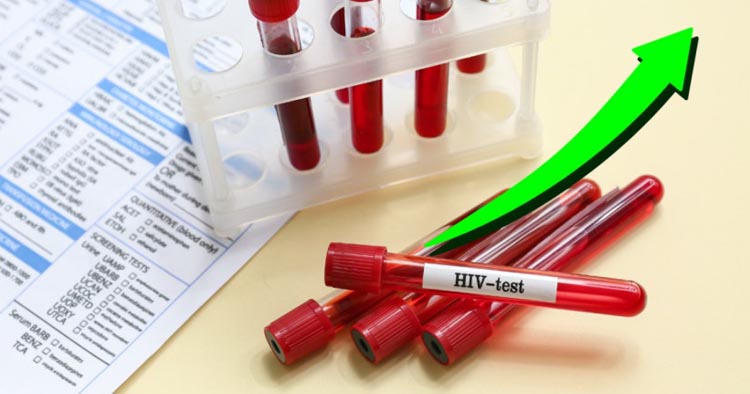
 After the year 2000, the number of new HIV cases in Bangladesh has seen the highest increase in a single year. A recent report shows that the number of new diagnoses has reached a record level, raising serious public health concerns.
Between November of last year and October of this year, 1,891 new HIV cases were identified—453 more than the previous year.
Interestingly, even though nearly 200,000 fewer people were tested compared to the previous year, the number of new infections still increased. This information was released yesterday (Monday) in the ‘HIV/AIDS Situation Report – 2025’.
During this period, 254 people died from HIV-related causes, which is lower than 326 deaths reported in the previous year.
On the occasion of World AIDS Day, the National AIDS/STD Control Program (NASP) under the Directorate General of Health Services (DGHS) shared these statistics at an event held at the auditorium of the National Institute of Cancer Research and Hospital.
Experts say it is essential to expand HIV testing and treatment services, strengthen coordination between government and community organizations, and increase awareness at all levels.
HIV weakens the immune system, increasing susceptibility to various infections and illnesses. Without treatment, it eventually progresses to AIDS (Acquired Immunodeficiency Syndrome).
In Bangladesh, the first HIV case was identified in 1989. Since then, a total of 14,313 cases have been recorded, with 2,666 deaths. Health authorities estimate that 18% of potentially HIV-infected individuals are unaware of their status, with the total estimated population at 17,480.
Year of Highest Increase
According to new data, over the past year, 1,421,000 people were tested for HIV, which is 191,000 fewer than the previous year.
Additionally, as part of health screening, 1,072,000 people were tested, slightly higher than the previous year.
A health department official explained that the overall decline in testing is due to fewer migrant workers being tested before traveling abroad. Last year, 1,305,000 migrant workers were screened, but this year the number dropped to 1,011,000.
Among those tested, 1,891 new HIV cases were identified, including 217 Rohingya individuals. Previously, the highest single-year increase was 329 cases in 2023.
Why Are HIV Cases Increasing?
When asked about the cause, Zubaida Nasrin, Deputy Director of NASP, said the rise is primarily due to increased testing among key populations.
The term “key population” refers to groups such as people who inject drugs, male and female sex workers, and transgender individuals.
According to the data, 117,000 people from key populations were tested this year, compared to 96,922 last year.
The closure of a government-supported program last June, which provided condoms, syringes, and preventive services, disrupted services for these groups.
When asked whether this disruption caused the rise in infections, Zubaida Nasrin said,The program closure created some challenges, but it cannot be directly attributed as the sole reason for the increase. Further research is needed to identify all causes.
Among the newly diagnosed patients:
* 56% are from key populations
* 12% are migrant workers
* 11% are Rohingya
* The remaining are from the general population
Gender distribution:
* 81% male, 18% female, 1% transgender
Marital status:
* 52% married, 42% unmarried, the rest widowed, divorced, or separated
Age distribution:
* 25–49 years: 63%
* 20–24 years: 21%
Decline in Treatment Coverage
The treatment rate has decreased from 78% last year to 74% this year.
A health department official said: An increasing number of patients have stopped medication for more than three months, which has lowered treatment coverage.
Among potentially HIV-infected individuals, 82% are aware of their status, and 91% of diagnosed patients have achieved viral suppression (a very low level of the virus in the body).